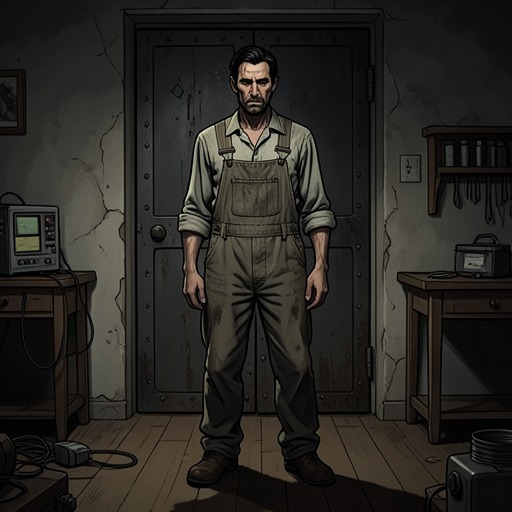
Gwynplaine’s childhood facial mutilation
The Man Who LaughsGwynplaine’s childhood facial mutilation explains the permanent, involuntary smile that governs his public identity and turns his appearance into a spectacle. The narrative presents the face not as a natural deformity but as the probable work of people who deliberately altered him when he was very young. The consequences endure into adulthood: crowds laugh at the expression, recoil from the person who bears it, and mistake an imposed mask for an account of his inner life.
Identity and reconstruction
The account begins with the contradiction between Gwynplaine’s face and its apparent effect. Its fixed expression seems to promise gaiety, but the narrator insists that laughter is not the same as joy. Close attention to the features suggests design rather than chance: the face appears too deliberately arranged to be the unaided work of nature. The chapter therefore turns from describing what spectators see to asking how such an expression could have been made.
The explanation is offered with degrees of uncertainty. The narrative judges it highly probable that people experienced in manipulating children deliberately reshaped Gwynplaine’s face at a tender age. Its suggestion that he was altered for the commercial prospect of future exhibition is presented as an inference, not as a fully witnessed account of the original decision. The episode itself is not shown as a remembered scene; instead, its nature is reconstructed from the result left behind.
A child prepared for exhibition
The account emphasizes the age at which the alteration must have occurred. Such an operation, it reasons, could only have been accomplished while Gwynplaine was very young, when he would have had little understanding of what was happening. His lack of a conscious memory of it does not, in this telling, disprove that it took place. The narrative also notes that methods for suppressing a patient’s suffering existed in the period, though they were understood through the language of magic rather than modern medicine.
The face is described as only one part of a broader preparation for performance. Gwynplaine’s body was otherwise left intact, and the narrative infers from his tall, well-made, agile build that he may once have been handsome. His physical training and unusual flexibility suited him to the work of a clown and mountebank. Together, the bodily training and the imposed facial expression suggest that he was made useful for a public profession, rather than simply injured without regard to what followed. The account nevertheless marks this reconstruction as probable, not as a record of every step or of the people who carried it out.
The permanent expression and its public cost
The alteration’s most consequential result is not merely that Gwynplaine looks as if he is laughing, but that the expression cannot reliably communicate what he feels. His face seems to laugh without his consent. Suffering, anger, astonishment, or pity intensify the appearance instead of correcting it; even tears would be read through the same fixed mask. A brief effort can suppress the expression, but the effort is painful and difficult to sustain, and emotion brings it back. The face thus becomes a barrier between inward experience and public interpretation.
That barrier shapes his encounters with other people. On seeing him, spectators laugh, then turn away; women in particular shrink from him after the first comic response gives way to horror. The crowd’s laughter is almost automatic, while the person who provokes it is difficult for them to contemplate. Yet the expression also brings professional renown: Gwynplaine becomes famous at fairs and crossroads for the spectacle of the horrible man who makes others laugh. The mutilation therefore supplies both a livelihood and a stigma, making the same imposed feature a source of public attention and personal exclusion.
Later meaning
When Gwynplaine addresses the peers, he interprets the face as evidence of political violence rather than as a private misfortune. He says that a king placed the laugh there and links it to enforced silence, rage, despair, and torture. He presents himself not as an isolated exception but as a symbol of people whose rights and capacities have also been deformed by their rulers. The mutilation’s significance consequently changes in his speech: the face that had been consumed as entertainment becomes an accusation directed at the audience that laughs at him.
That later interpretation depends on the original contrast between a smiling appearance and suffering within. The imposed expression hides pain beneath a mask that spectators readily accept as happiness, just as Gwynplaine argues that public celebration can conceal the suffering of the people. His childhood injury thus remains active far beyond the event itself: it shapes his work, governs how strangers respond to him, and gives him the image through which he challenges aristocratic power. The narrative’s account preserves uncertainty about the exact circumstances of the operation while making its enduring consequence unmistakable: a child’s face was turned into an instrument of spectacle, and the spectacle could never speak for the child without being mistaken for a laugh.